
Have questions or need our services? Our team is ready to assist you with reliable solutions and prompt support. Contact us today to discuss your requirements.
By Progressive Scrappers | Last updated: October 2026
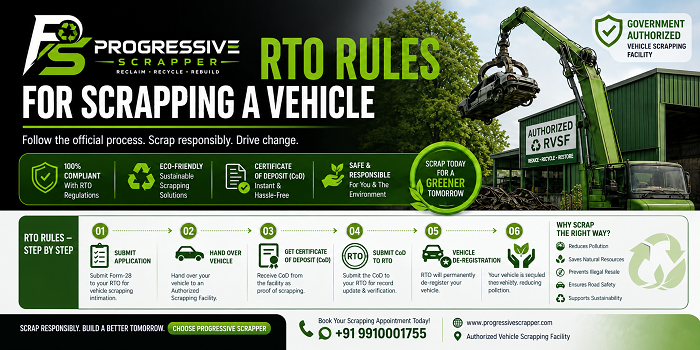
The RTO rules for scrapping vehicles that owners must follow are simple in principle: hand your vehicle to a government-authorised scrapping facility (RVSF), receive a Certificate of Deposit, and make sure your RC is cancelled. Under the current rules, the RVSF applies for the cancellation online, and the RTO cancels the RC within seven days of that application.
It’s not only about handing over the car; the RC should be canceled; otherwise, the vehicle will continue being registered under your name.
The majority of forms are submitted by RVSF online on the Vahan website; thus, you won’t have to stand in queues at the RTO.
RTO issues ‘no dues’ within six days and cancels the RC within seven days from the submission of the application by RVSF.
You remain liable for the vehicle till the issuance of the Certificate of Deposit.
Get rid of all the challans and loans first; they are causing the major delays.
The process of scrapping in India is covered by the Motor Vehicles (Registration and Functions of Vehicle Scrapping Facility) Rules, 2021, amended in 2022, along with the additional clauses under the CMVR. In layman's terms, the RTO rules related to vehicle scrapping have three functions. The first one is assigning the job of scrapping the vehicle to the RVSF, along with the documentation process. The second one is to send the documents via the Vahan portal.
Here are two things that you should know right from the beginning. You can have your vehicle that has been registered in one state destroyed in an RVSF of another state, although the application for 'no dues' will be sent to the authority that registered the vehicle in the state in which it is currently registered. And according to the CMVR, you will be liable for any occurrence of the vehicle till the date of issue of the Certificate of Deposit. If the terminology is new to you, our guide to the RVSF full form explains how these facilities are recognised.
The fastest way to understand the vehicle deregistration process India follows is to see who owns each stage.
|
Stage |
You (owner) |
RVSF |
RTO |
|
Before handover |
Gather documents, clear challans and loan entries |
Checks vehicle and ownership details on Vahan |
None |
|
Handover |
Apply digitally (Form 2), be present when the RC is defaced |
Defaces or punches the RC, issues a digitally signed Certificate of Deposit |
None |
|
No dues |
Request goes through the RVSF (Form 28A) |
Files the request on Vahan |
Grants 'no dues' (Form 28B) within six days |
|
Cancellation |
Keep copies, track status |
Applies for cancellation (Form 25A) |
Verifies the papers and cancels the RC within seven days |
|
Final record |
Collect the scrapping certificate |
Issues the Certificate of Vehicle Scrapping (Form 4), sends the physical RC to the RTO within 30 days |
Cancellation shows on the portal in real time |
The most important time-saving thing that you need to have is your paperwork sorted. While there may be slight variations in the required list depending on the state and the type of vehicle, the following is what is expected from the RTO when scrapping your car. The Certificate of Deposit, verified by the RTO officials, is issued by your RVSF.
|
Document |
Comes from |
Why it matters |
|
Original Registration Certificate (RC) |
You |
The RVSF defaces or punches it in your presence |
|
Aadhaar or other ID proof |
You |
Confirms you are the registered owner |
|
Address proof |
You |
Must match the RC records |
|
PAN card, where applicable |
You |
Needed for payment records |
|
Loan-closure proof or lender NOC |
You, from your bank |
Hypothecation must be cleared before cancellation |
|
Challan and dues clearance |
You |
Avoids delays at the 'no dues' stage |
|
Digital application (Form 2) |
You, via the RVSF |
Starts the deposit of the vehicle |
|
Certificate of Deposit |
RVSF |
Proof that the vehicle was surrendered for scrapping |
|
Certificate of Vehicle Scrapping (Form 4) |
RVSF |
Proof of final disposal |
We've explained both certificates in detail in our scrap certificate guide.
People often ask us how to cancel RC after scrapping. When the paperwork is in order, the sequence is short:
Choose an authorised RVSF. Confirm that it is government-authorised and has Vahan access, since only such a facility can issue valid certificates.
Apply and deposit the vehicle. You apply digitally (Form 2) to the RVSF or its collection centre, which verifies your details on Vahan.
Watch the RC being defaced. The RVSF defaces or punches your RC in front of you and issues a digitally signed Certificate of Deposit.
Request 'no dues'. The RVSF raises it on Vahan (Form 28A) and the RTO grants it (Form 28B) within six days.
The RVSF applies for cancellation. It files Form 25A with the Certificate of Deposit and the 'no dues' approval, and the RTO verifies them and cancels the registration within seven days.
Collect your final certificate. After dismantling, the RVSF issues the Certificate of Vehicle Scrapping and sends the physical RC to the RTO within 30 days.
Add the six-day and seven-day windows together, and RC cancellation after vehicle scrapping can close in roughly two weeks on a clean file. In our experience at Progressive Scrappers, most files close within [X] days. Delays almost always trace back to pending challans, loan entries, or mismatched details on the RC.
A few habits make this smoother. Photograph your RC and ID before handing anything over. Keep digital copies of both certificates. Note the date your vehicle was accepted, since that's your reference if you ever need to follow up with the RTO.
The word 'NOC' covers two different clearances, and mixing them up causes confusion.
This is the clearance people usually mean when they ask about an RTO NOC for scrapping a vehicle. It confirms that no dues are pending against the vehicle, and it is requested through your RVSF on Vahan. You don't chase it yourself, but you can make it faster by clearing problems beforehand.
Challan clearance before scrapping a vehicle is something we always recommend, even when nobody asks for it up front. Unpaid challans can stall the process, and you don't want to find out after your vehicle has been dismantled. Check your challan status online and settle anything outstanding. If the vehicle was bought on a loan, the lender's name is still on the RC, so get loan-closure proof or a lender NOC before you hand it over.
Almost everything runs online now. Authorised facilities get access to the Vahan database, enter the scrapping details themselves, and issue certificates digitally. Vahan and Parivahan vehicle scrapping records are how you, the RVSF, and the RTO all see the same status. Cancellation is meant to show on the portal in real time, and you can check your vehicle's registration status on the Parivahan portal. Keep a screenshot of the final status for your files.
Skipping this step is risky. Until the registration is cancelled, the vehicle exists on paper and is tied to your name. A challan, an accident, or misuse involving that registration number can come back to you, and proving years later that the vehicle was scrapped gets difficult. Cancelling the RC is what gives you a clean exit.
It matters even more in Delhi, where age-based restrictions apply to old petrol and diesel vehicles. Our explainer on the 10/15-year vehicle ban in Delhi covers those rules.
Handing the vehicle to a dealer who can't issue a Certificate of Deposit through Vahan.
Assuming dismantling and deregistration are the same thing.
Handing over the car before clearing challans or the loan entry.
Not keeping copies of the RC, ID, and certificates.
Owners who read up on the RTO rules for scrapping vehicle registrations before they start tend to avoid all four.
Progressive Scrappers is a government-authorised vehicle scrapping facility serving Delhi NCR, and documentation support is part of every job. If you're looking for an authorized scrap dealer for RC cancellation in Delhi that owners can trust, here's how we help:
Free doorstep pickup across Delhi NCR
A document check before pickup, so nothing is missing later
Certificate of Deposit issued once your vehicle is accepted
RTO paperwork assistance for vehicle scrapping, from challan checks to the 'no dues' request
Vehicle scrapping with RTO documentation support until your Certificate of Vehicle Scrapping is issued
Want to know what your vehicle is worth and what paperwork it needs? Get an instant quote, and our team will walk you through it.
Scrapping a vehicle properly means closing two chapters: the physical one at the facility and the legal one at the RTO. Follow the RTO rules for scrapping a vehicle, keep your documents handy, and don't leave your RC active. Your Certificate of Deposit can also help when you buy a new vehicle, as our guide on scrap incentive on new car purchase explains. Rules change, so confirm current requirements on the Parivahan portal or with your RTO before you begin.
Sources: MoRTH notification amending the CMVR (rules 52B and 58A) and the Motor Vehicles (Registration and Functions of Vehicle Scrapping Facility) Rules, 2021 as amended in 2022.
The rules give the RTO six days to grant 'no dues' and seven days to cancel the RC after the RVSF applies. A clean file can close in about two weeks.
Usually not. The RVSF files the requests on Vahan, but practice can vary by state, so confirm with your RTO.
No. The RVSF's cancellation application needs the Certificate of Deposit and the 'no dues' approval, and the RTO verifies both.
You can hand it over, but clear them first. Pending dues can delay the 'no dues' approval and the cancellation.
Yes. A vehicle registered in one state can be scrapped at an RVSF in another, and the 'no dues' request goes to the registering authority of the state where it is registered.
In practice it is part of the process, and it is what formally closes your ownership on the record. Your RVSF initiates it for you.
We are a trusted vehicle scrapping and recycling company dedicated to safe dismantling, responsible metal recovery, and environmentally sustainable recycling solutions.
Gate No 1, B4/304 1st Floor, near Metro Station Keshav Puram, Tri Nagar, New Delhi, Delhi
Developed by Webquickindia.com
Share your details and your vehicle information. We will contact you with the next steps.