Have questions or need our services? Our team is ready to assist you with reliable solutions and prompt support. Contact us today to discuss your requirements.
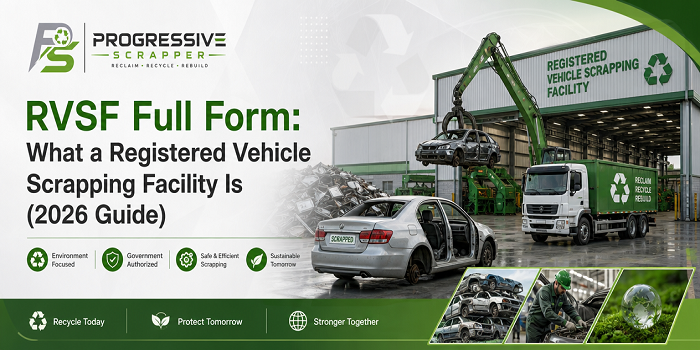
RVSF full form stands for Registered Vehicle Scrapping Facility — a government-authorised centre permitted to legally dismantle and scrap end-of-life vehicles in India. If you've ever wondered what happens to a car or bike once it's too old to drive, or why the government insists on using an authorised centre instead of the local scrap dealer down the road, this guide breaks it down in plain language.
At Progressive Scrappers, we deal with vehicle owners every week who've never heard the term until they're actually staring at an old vehicle they need to get rid of. So let's start from the basics and work our way through everything that matters.
An RVSF, or Registered Vehicle Scrapping Facility, is an establishment that holds official registration under the Motor Vehicles (Registration and Functions of Vehicle Scrapping Facility) Rules, 2021. These rules were framed under the Motor Vehicles Act, 1988, and they exist for one clear reason: to bring vehicle scrapping under formal government oversight instead of leaving it to informal, unregulated scrap dealers.
Registration is issued either by the Ministry of Road Transport and Highways (MoRTH) or by the concerned State Transport Department. Once granted, a facility is legally allowed to dismantle vehicles, verify ownership, and issue the paperwork needed to close a vehicle's records permanently.
The idea of the RVSF grew out of India's Vehicle Scrappage Policy, introduced in 2021. The policy's goal was straightforward — get old, polluting, and unsafe vehicles off the road. Under this framework, commercial vehicles older than 15 years and private vehicles older than 20 years must pass a fitness test, and vehicles that fail are meant to be scrapped through an authorised centre rather than sold off informally.
This is where the full form of RVSF starts to matter practically, not just as a definition you look up once and forget.
This is usually the first question people ask once they understand what an RVSF actually is.
|
Factor |
Registered Vehicle Scrapping Facility |
Local Scrap Dealer |
|
Legal deregistration |
Yes, through official records |
No |
|
Certificates issued |
Yes (CoD and CVS) |
No |
|
Government incentives |
Eligible |
Not eligible |
|
Future legal liability |
Closed permanently |
Vehicle may remain traceable to you |
|
Process transparency |
Documented and verifiable |
Informal, undocumented |
The biggest risk with an unauthorised dealer isn't just missing out on money — it's that your vehicle's ownership record may never actually close. If it's later misused, traced back to your name, that liability doesn't just disappear because you handed the keys over informally.
A lot of confusion around the RVSF full form comes from people not knowing there are two separate certificates involved, not one.
This is the financial document. It's what makes you eligible for a discount when purchasing a new vehicle, along with any applicable road tax rebate offered by your state government. Many manufacturers also offer their own additional discount when a CoD is presented at the time of purchase.
This is the legal document. It proves your vehicle was dismantled properly at an authorised facility and is what allows the Regional Transport Office (RTO) to permanently deregister the vehicle from official records.
Put simply: CoD gets you money, CVS gets you legal closure. You need both, and only a genuine Registered Vehicle Scrapping Facility can issue either one.
Here's what happens, step by step, once you hand your vehicle over to a facility like Progressive Scrappers:
Intake and document check — Your registration certificate, ID proof, and (if applicable) an authorisation letter are verified.
Ownership verification — The facility confirms you're legally entitled to have the vehicle scrapped.
Stolen vehicle check — Before anything is touched, the vehicle's details are cross-checked against police and crime records databases to rule out theft or criminal involvement.
Certificate of Deposit issued — Once verification clears, the CoD is generated.
De-pollution — Hazardous components such as engine oil, coolant, battery, and airbags are safely removed and disposed of following environmental norms.
Dismantling and material recovery — The vehicle is broken down, and recoverable materials like steel, aluminium, and plastic are separated for recycling.
Certificate of Vehicle Scrapping issued — Confirming the vehicle no longer exists.
Deregistration — The vehicle's record is closed with the RTO, ending your legal association with it entirely.
Knowing this sequence matters because it shows why the process takes a little longer at an authorised centre than at an informal scrap yard — every step is designed to protect you, not just to move metal.
Keep these ready before visiting any RVSF:
Original Registration Certificate (RC)
Valid ID proof of the owner
Address proof
Authorisation letter, if someone other than the RC holder is submitting the vehicle
Pollution Under Control (PUC) certificate, if available
Insurance documents, if applicable
Having everything in order upfront usually cuts the process down by a visit or two.
The rules governing Registered Vehicle Scrapping Facilities aren't static. In mid-2026, the Ministry of Road Transport and Highways proposed a set of amendments to the original 2021 rules, aimed at tightening operational standards and broadening the definition of what counts as an end-of-life vehicle. In practical terms, this means the criteria for which vehicles must go through an RVSF are likely to widen going forward — so this is a space worth watching if you own an older vehicle you're planning to keep for a few more years.
Last updated: 2026.
Before you commit to any facility:
Ask to see their registration certificate — a legitimate centre won't hesitate to show it
Confirm they issue both a CoD and a CVS, not just one
Be cautious of anyone offering to skip documentation "to save time"
Understanding the RVSF full form is really the starting point of a much bigger decision — where you choose to scrap your vehicle, and whether that choice is legally sound. At Progressive Scrappers, we handle every step of this process directly, so you're not left chasing paperwork after the vehicle is already gone.
Yes. AVSF (Authorized Vehicle Scrapping Facility) and RVSF are used interchangeably to refer to the same government-registered centres.
It's difficult but not always impossible — you'll typically need additional documentation and, in some cases, police verification. It's best to check directly with your chosen facility.
This depends on your vehicle's weight, material composition, and current scrap rates, plus any applicable CoD-linked rebate. There's no fixed universal figure.
No. Road tax is a state subject, so rebate percentages and eligibility can vary depending on where the vehicle is registered.
It stands for Registered Vehicle Scrapping Facility — a government-approved centre for legally scrapping old vehicles.
We are a trusted vehicle scrapping and recycling company dedicated to safe dismantling, responsible metal recovery, and environmentally sustainable recycling solutions.
Gate No 1, B4/304 1st Floor, near Metro Station Keshav Puram, Tri Nagar, New Delhi, Delhi
Developed by Webquickindia.com
Share your details and your vehicle information. We will contact you with the next steps.