Have questions or need our services? Our team is ready to assist you with reliable solutions and prompt support. Contact us today to discuss your requirements.
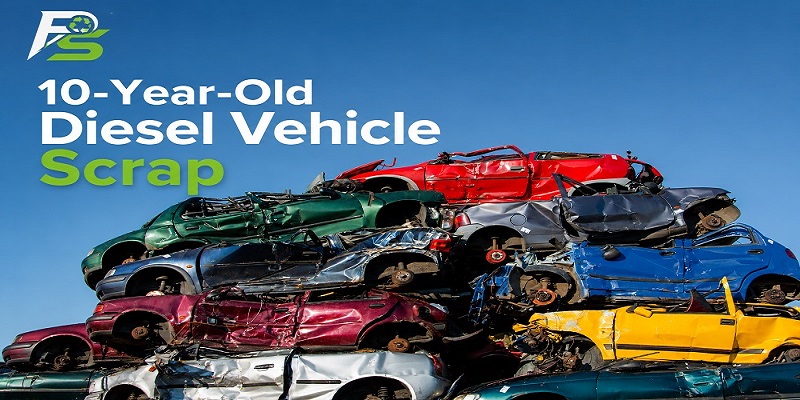
If you're searching for information on 10-year-old diesel vehicle scrap in Delhi, there's a good chance you've also come across conflicting information — and honestly, that's fair, because the rules genuinely have shifted recently. For years, the position was simple: diesel vehicles past 10 years were banned outright in Delhi NCR, no exceptions. That's no longer the full picture, and getting this wrong, in either direction, can cost you.
Progressive Scrapper stays on top of these changes specifically so our customers don't have to untangle it themselves. We're recognized by the Ministry of Road Transport and Highways (MoRTH) for authorized vehicle scrapping, and below, we've laid out exactly where things currently stand — including a genuinely important update from late 2025 that most people haven't heard about yet.
The 10-year diesel limit isn't a recent invention. It traces back to a 2014-15 order from the National Green Tribunal, later upheld by the Supreme Court in 2018, which directed Delhi's transport authorities to stop registering diesel vehicles older than 10 years and petrol vehicles older than 15. The reasoning was straightforward: ageing diesel engines were contributing disproportionately to the capital's air pollution, and an age-based cutoff was seen as the most enforceable way to phase them out.
For close to a decade, this was applied as an absolute rule — if your diesel vehicle crossed 10 years, it didn't matter how well-maintained it was or what emission standard it met. Authorities began actively seizing vehicles that fit the age criteria, whether they were being driven or simply parked outside someone's home.
This is the part that genuinely matters if you're trying to make a decision right now. In August 2025, the Supreme Court initially paused all coercive action against over-age vehicles in Delhi NCR while it reconsidered whether a blanket age-based ban was actually fair. Then, in a more specific ruling on 17 December 2025, the Court clarified its position: the protection from seizure applies specifically to BS-IV and BS-VI vehicles. Older BS-III and earlier vehicles remain fully subject to seizure and scrapping, regardless of exact age.
In practical terms, this means a well-maintained, 10-year-old diesel vehicle that meets BS-IV or BS-VI emission standards is currently shielded from being seized purely because it's crossed the 10-year mark. This matter is still being finalised by the Court, so it isn't a permanent settled position — but as things stand, the blunt "every diesel vehicle over 10 years gets seized" rule is no longer accurate for BS-IV/BS-VI vehicles.
Even with this update, a few things are worth being realistic about:
The interim court order hasn't yet been reflected in the RTO's own registration systems, which continue to treat 10-year-old diesel vehicles as due for deregistration. That mismatch between the legal protection and the administrative record can still create friction if you're stopped or checked.
During severe pollution episodes, when Delhi's air quality index crosses 450, the Commission for Air Quality Management enforces Stage-IV of the Graded Response Action Plan — and under this, BS-IV diesel vehicles are barred from the roads temporarily, even though they're otherwise protected from permanent seizure based on age.
Delhi has made the "No PUC, No Fuel" rule permanent, using number-plate recognition cameras at petrol pumps to flag vehicles automatically. Owners have reported discovering their vehicle's flagged status this way, sometimes despite technically being road-legal under the newer BS-IV protection.
The 2025 ruling was explicit that BS-III and earlier vehicles can still be impounded and scrapped on the basis of age alone.
Given all of this, for a lot of owners, scrapping the vehicle through a proper, authorized process remains the more practical route — not because it's strictly mandatory in every case anymore, but because navigating this legal grey zone day-to-day carries real friction, and an outdated, ageing diesel vehicle rarely has enough remaining value to justify the hassle.
Delhi's 2024 guidelines for handling end-of-life vehicles set out a fairly specific process. If a vehicle is impounded for the first time and it meets the eligibility criteria, it can be released back to the owner — but only after they sign an undertaking committing to either remove the vehicle from Delhi entirely or store it in private parking, not a shared residential or public lot. If the same vehicle is impounded a second time, it isn't released again; it goes straight to scrapping. Diesel transport vehicles over 10 years old are treated more strictly still, with no release option on repeat impoundment.
If your vehicle is genuinely scrapped through this process, the scrap value is required to be paid to you within 15 days of the vehicle being accepted by a Registered Vehicle Scrapping Facility (RVSF). If you'd rather move the vehicle out of Delhi instead of scrapping it, that requires obtaining a No Objection Certificate (NOC) before relocation.
Given how much uncertainty still surrounds enforcement, waiting for an impoundment to force the issue is rarely the better option — you lose control over timing, valuation, and the process itself. Handling it proactively through an authorized facility means you decide when it happens and what you get for it.
We follow the complete government-recognized process:
Diesel vehicles, especially SUVs and larger sedans, often carry more weight than comparable petrol models, which tends to translate into higher recoverable scrap value — commonly somewhere in the range of ₹15,000 to ₹90,000, though the exact figure depends on your specific vehicle's weight, model, condition, and current scrap metal rates. An in-person inspection is really the only reliable way to know where your vehicle falls in that range.
For the broader national framework behind these rules, the Ministry of Road Transport and Highways publishes official guidance on vehicle scrapping and end-of-life vehicle policy on its website. For our full range of services, including petrol vehicles and two-wheelers, our main car scrap dealers in Delhi page covers the complete picture, and our 15-year-old petrol car page walks through that specific process.
Whether your vehicle is currently protected under the newer BS-IV/BS-VI rules or falls into the older BS-III category still facing strict enforcement, scrapping it through an authorized facility remains the cleanest way to close out your ownership properly. Reach out with your vehicle's details, and our MoRTH-recognized, Tri Nagar–based team will take care of the rest.
It depends on its emission standard. As of the Supreme Court's December 2025 order, BS-IV and BS-VI vehicles are currently protected from seizure based on age alone, while BS-III and older vehicles remain subject to seizure. This is still an interim position, and Delhi's own registration records haven't fully caught up with it.
You can, but be aware of GRAP-IV restrictions during severe pollution days, and the fact that fuel-pump ANPR systems may still flag your vehicle regardless of its technical legal status. Many owners find scrapping simpler than managing this ongoing ambiguity.
On a first impoundment, you may be able to reclaim it with an undertaking to remove it from Delhi or store it privately. A second impoundment typically results in direct scrapping, without release.
Typically somewhere between ₹15,000 and ₹90,000, depending on weight, model, and condition — we provide an exact figure only after inspecting the vehicle.
Yes — RC cancellation support, a Certificate of Deposit, and a Certificate of Vehicle Scrapping once the process is complete.
We are a trusted vehicle scrapping and recycling company dedicated to safe dismantling, responsible metal recovery, and environmentally sustainable recycling solutions.
Gate No 1, B4/304 1st Floor, near Metro Station Keshav Puram, Tri Nagar, New Delhi, Delhi
Developed by Webquickindia.com
Share your details and your vehicle information. We will contact you with the next steps.