
Have questions or need our services? Our team is ready to assist you with reliable solutions and prompt support. Contact us today to discuss your requirements.
By the Progressive Scrapper team | Government-authorised vehicle scrapping, Delhi NCR | Last updated: October 2026
The main types of scrap are ferrous scrap (iron and steel), non-ferrous scrap (copper, aluminium, brass and similar metals), vehicle scrap, and e-waste. They differ in what they're made of, how they're recycled and what they're worth, so it helps to know which one you're holding before you call a buyer.
Everyone sees scrap metal and thinks that all of it is worth pretty much the same thing. They're wrong because one kilogram of copper wire and one kilogram of rusting iron sheet have very different values. We sort scrap on a daily basis at our authorised facility in Delhi NCR, and the first question we ask anyone who brings us scrap is straightforward: What kind of material is this? This article aims to answer that question clearly, using our own experience sorting scrap metal. It explains the various kinds of scrap metal, how you can identify them yourself, how they're classified by scrap dealers, what goes into a scrapped car, and how you can sell without being ripped off.
What is scrap?
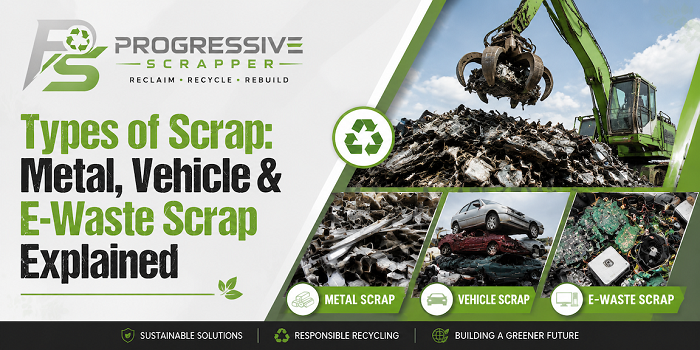
Main types of scrap explained
Ferrous vs non-ferrous differences
How to identify scrap at home
Scrap by source
How dealers grade scrap
What a scrapped car breaks down into
Scrapping a vehicle in India
What affects scrap value
How to sell scrap in Delhi NCR
FAQs
Scrap is any material that has been rendered useless in its primary purpose but has some value to be retrieved, typically in the form of metals. In order to understand what scrap metal means, imagine the leftover materials from used-up cars, machines, buildings, and appliances that can be recycled and used again in some way.
This is where the second life of scrap begins through the recycling process. The material goes through collection, sorting, cutting/shredding, melting, and casting to create new raw material. Scrap metals use much less energy compared to mining and processing new metal ores, hence being more environmentally friendly too. All kinds of scrap listed in this guide will undergo the same process, with the only exception of sorting and melting steps.
Dealers price by material, not by pile. If you hand over mixed metal, the buyer usually quotes toward the cheapest metal in the heap, because sorting it costs them time. If you separate it first, you keep that difference. Knowing the types of scrap you have also helps you spot a fair rate, so you don't end up selling copper at an iron price.
Dealers sort material using a simple scrap metal classification: first by whether it contains iron, then by source and purity. These are the types of metal scrap with examples you'll meet most often.
Ferrous scrap is composed of iron, which means that it can be picked out using a refrigerator magnet. This is the largest type in terms of volume. Various forms of ferrous scrap include old automobile bodies, steel girders, machine parts, tubes, railroad tracks, cast iron articles, and domestic appliances.
Rust does not render this material useless since it is always melted in a furnace regardless. Its unit price is lower compared to non-ferrous metals, but its volume is the main factor behind its dominance in the industry.
The metal in non-ferrous scrap does not contain iron; hence, it does not attract a magnet. They are rust-resistant and therefore cost more than iron per kilogram. Examples of non-ferrous scrap include copper wires and pipes, aluminum sheets and wheels, brass taps and joints, zinc and lead batteries, and in most cases, stainless steel.
Stainless steel is an exception. It is made of iron, but its grades do not respond much to a magnet.
The types of vehicle scrap we handle include end-of-life cars, two-wheelers, trucks, and commercial vehicles. A scrapped vehicle isn't one material but many, which is why it's priced differently from a pile of plain metal. We break one down in a section further below.
The types of e-waste scraps comprise old mobile phones, laptops, circuit boards, chargers, and batteries. They contain small quantities of copper, silver, gold, and other precious metals, apart from some toxic materials. Among all the kinds of scraps, e-waste requires the most cautious treatment; hence, you should hand it over to authorized recyclers rather than the trash bin.
Plastic, rubber, paper, and glass are recyclable too. They pay less per kilo, but they keep a lot of material out of landfills.
Knowing the difference between ferrous and non-ferrous metals helps you sort correctly and negotiate better. Here's the short version.
|
Feature |
Ferrous scrap |
Non-ferrous scrap |
|
Contains iron |
Yes |
No |
|
Magnetic |
Yes |
No |
|
Rust |
Rusts over time |
Resists corrosion |
|
Value per kilo |
Lower |
Higher |
|
Typical examples |
Car body, steel beams, pipes |
Copper wire, aluminium, brass |
Keep ferrous and non-ferrous scrap in separate piles. Mixed loads are harder to grade and usually get priced toward the lower-value metal.
You don't need a lab to tell the common types of scrap apart. Three quick checks go a long way:
The magnet test: if a magnet sticks firmly, it's ferrous. If it doesn't, it's non-ferrous or a weakly magnetic grade such as some stainless steel.
The colour test: scratch a small spot. Copper looks reddish, brass looks yellow, and aluminium looks silvery and feels very light.
The weight test: lead and copper feel heavy for their size, while aluminium feels surprisingly light.
None of this replaces a dealer's proper grading, but it stops you from mixing piles by mistake.
The same metal can reach a dealer from very different places, and the source affects how clean and how valuable it is.
Household scrap: old utensils, appliances, cycles, grills and cables.
Industrial scrap: offcuts, machine parts and factory leftovers, usually cleaner and sold in bulk.
Construction scrap: rebar, steel sections, pipes and wiring from demolition.
Automotive scrap: end-of-life cars and bikes, plus batteries, wheels and catalytic converters.
Clean, single-material loads from industry tend to grade better than mixed household heaps.
Grading refers to the act through which the dealer assesses the nature of the metal, purity of the load, and the contaminants. Here is where the grading of all grades in terms of monetary value takes place. Metals with bulk and without contamination such as metal plates are high-grade materials than light metals such as rusty metal sheets. Copper bare wires have a higher grade than coated wires.
Aluminum with metal screws is low-grade until the screws are removed. Grades and their rates differ from one dealer to another; hence, it is important to know how grades are graded.
This is where the types of scrap become practical. The car scrap parts and materials from a single vehicle usually include:
Steel body and frame, normally the largest share by weight
Aluminium wheels and engine components
Copper wiring and the starter motor
The catalytic converter, which holds small amounts of precious metals
A lead-acid battery
Rubber tyres, plastic panels and glass
When cars are stripped down at an authorized scrap yard, most of their weight can then be recycled back into the recycling process. Thus, the Scrap value of the old car to be scrapped is measured not only by how old it is but also by the weight of the car, what model it is, and the state of its parts.
There is a huge difference between a kilogram of copper wire and a car. In the case of a scrap car, one needs a registered vehicle scrapping facility (RVSF). This is because of the vehicle scrappage policy framework set up by the government, which is different. You will receive a Certificate of Deposit upon the submission of the car. Based on the vehicle scrappage policy of the state at the present time, this certificate can be useful to avail road tax concession and other discounts on a new car.
Keep handy your RC book, ID Proof, and Address Proof. The age limit for old cars in Delhi NCR is another factor that influences the decision of scrapping.
Whatever you're selling, a few things decide the final price:
Type of metal: non-ferrous usually beats ferrous, so different types of scrap earn different rates.
Weight: the heavier the load, the more it earns.
Purity and sorting: clean, separated material gets a better grade.
Market rates: the scrap metal price in India moves with global metal prices, so last month's quote may not hold today.
Condition: rust, dirt, and mixed materials pull the price down.
A tip from the floor: always ask for the rate on the day you sell, and ask what it's based on.
The selling of scrap can be easy if you do so by following some simple steps.
Group the scrap materials according to categories like iron, copper, aluminium, and e-scrap.
Get to know the latest price from at least two scrap dealers.
Select the registered scrap buyer, as not all scrap dealers in Delhi NCR are registered. Get the certificate for the same.
Have all the necessary documentation in place, no matter what kind of scrap you sell.
If you need to sell your scrap vehicle in Delhi, then the process differs from this, which has been discussed above. Progressive Scrapper provides scrap car pickup services that can be booked online by the residents of Delhi.
Knowing the type of scrap you are dealing with is the first step to make sure that you are getting what you deserve. Separate the scrap, know its value in the market, and only sell it through an authorised dealer. In case you have a car that you no longer use, Progressive Scrapper will be there for you.
Ferrous scrap (iron and steel), non-ferrous scrap (copper, aluminium, brass) and e-waste scrap are the three most commonly discussed types of scrap. Many dealers also treat vehicle scrap as its own category, because a single car contains both ferrous and non-ferrous materials.
Generally, non-ferrous metals such as copper fetch the highest price per kilo, followed by aluminium and brass. Ferrous scrap pays less per kilo, but large volumes can still add up. Rates change daily, so always check the current price.
Aluminium is non-ferrous. It contains no iron, doesn't rust and isn't magnetic, which makes it light, durable and more valuable than iron or steel scrap.
Stainless steel is an iron-based alloy, but many common grades are weakly magnetic or non-magnetic. Dealers often treat it as its own grade, so test it before you add it to either pile.
Use a magnet. If it sticks, the metal is ferrous. If it doesn't, it's non-ferrous, or a weakly magnetic grade like some stainless steel. Colour helps too: copper looks reddish and brass looks yellow.
We are a trusted vehicle scrapping and recycling company dedicated to safe dismantling, responsible metal recovery, and environmentally sustainable recycling solutions.
Gate No 1, B4/304 1st Floor, near Metro Station Keshav Puram, Tri Nagar, New Delhi, Delhi
Developed by Webquickindia.com
Share your details and your vehicle information. We will contact you with the next steps.