Have questions or need our services? Our team is ready to assist you with reliable solutions and prompt support. Contact us today to discuss your requirements.
By Progressive Scrapper | Last updated: October 2026
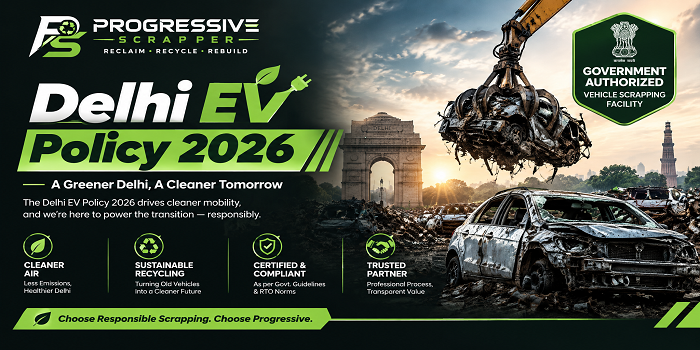
Quick Answer: The Delhi EV Policy 2026 came into effect on 1 July 2026 and stays in force until 31 March 2030. If you scrap a Delhi-registered BS4 or older car at an authorised facility and buy a new electric car within six months of receiving your Certificate of Deposit (CoD), you can claim a ₹1 lakh scrapping incentive. Eligible EVs also get a 100% road tax and registration fee waiver.
If you have been using a petrol- or diesel-driven vehicle in Delhi for the past decade or more, you must have thought about the Delhi EV Policy 2026. This program pays a reward to those who scrap their old and polluting vehicles and adopt an electric vehicle. However, what makes things tricky here is that the qualifying criteria for the incentive and the process to be followed remain vague, which could result in disqualification from the scheme.
We at Progressive Scrapper deal with the scrapping of vehicles in Delhi NCR on a daily basis; hence, we come across the queries of owners very often. In this guide, we will help you understand everything related to the policy from the perspective of the scrapping process.
What's inside
What the policy is
Benefits at a glance
Scrapping rules and eligibility
Incentives by vehicle type
How to claim, step by step
Documents you need
Scrap or sell your old car
FAQs
The policy, which is popularly known as the Delhi EV Policy 2.0, has come to replace the first EV policy of Delhi, which was launched in 2020. The previous policy had become invalid in August 2023 but was extended multiple times during the drafting process of the new policy. Transport Department of the Government of NCT of Delhi published its draft on 11th April 2026 and invited suggestions till 11 May, and the Delhi Cabinet approved the framework in late June. The policy was implemented from 1 July 2026 for a period of four years ending on 31st March 2030.
Cleaner Air is the primary objective of the policy. Instead of providing support everywhere, the government is focusing on those areas that contribute maximum pollution, like commercial vehicles, two-wheelers, three-wheelers, and old petrol and diesel cars. Total investment is expected to be around ₹15,000 crore.
What is a Certificate of Deposit (CoD)? It's the document an authorised scrapping facility gives you when you hand over your vehicle. It proves the car has been deposited for scrapping, and you'll need it to claim the incentive.
Here's what the policy offers Delhi residents:
Exemption from road tax and waiver of registration charges: 100% for qualifying battery electric vehicles that are registered in Delhi till 31st March 2030.
Scrapping bonus worth up to ₹1 lakh if you scrap your BS4 or older 4-wheeler vehicle and purchase an electric car.
Subsidies for electric two-wheelers are available on a sliding scale of ₹30,000 in the first year, ₹20,000 in the second year, and ₹10,000 in the third year.
Incentives are provided for electric three-wheelers and small electric cargo vehicles.
Increased public charging stations and electric buses.
The tiered design is deliberate. The sooner you buy, the more support you get, so waiting rarely pays off.
This is what confuses most people, and this is the most stringent aspect of the Delhi EV policy 2026. Let us answer them in questions.
The Delhi EV policy scrapping incentive is meant for vehicles registered in Delhi. Your old car must be BS4 or older, which covers most petrol and diesel cars sold before April 2020. A car registered in another state won't qualify. Not sure about your car's emission norm? Check the registration certificate or ask the manufacturer.
On submission of the used car to the scrap yard, you get the CoD certificate, which is normally issued upon handover. It serves two purposes: first, it validates the scrapping process, and secondly, it starts your time clock. You are then entitled to a period of six months starting from the date of issuance of the CoD certificate within which you must purchase your EV.
Based on published sources, this amount is available for electric cars priced at or below ₹30 lakh ex-shelf rate. With respect to private or non-transport cars, the ₹1 lakh subsidy is only applicable to the first 1,00,000 applicants of these categories. This is on a “first-come, first-served” basis, so there shouldn’t be any delay.
In Delhi NCR, diesel vehicles older than 10 years and petrol vehicles older than 15 years can't stay on the road. If your car is close to those limits, scrapping isn't really optional for long, so you may as well use the incentive.
However, these published notices pertain only to the applicant cap for private cars . There might be different requirements for commercial and taxi cars; hence, it is best to refer to the official notice or contact us.
The incentives differ quite a bit by category. This table shows the scrapping incentive for each one, based on the draft policy.
|
Vehicle type |
Scrapping incentive |
Road tax and registration |
|
Electric car |
Up to ₹1,00,000 |
100% waiver |
|
Electric two-wheeler |
₹10,000 |
100% waiver |
|
Electric three-wheeler (L5M) |
₹25,000 |
100% waiver |
|
Electric goods carrier (N1) |
₹50,000 |
100% waiver |
Delhi EV subsidy for electric vehicles is available via scrappage only, so the subsidy is not in the form of a purchase subsidy. However, the two-wheeler purchasers do receive the purchase subsidy as described earlier. Figures related to two-wheelers, three-wheelers, and goods carriers have been taken from the draft and therefore should be confirmed from the actual notification before proceeding further.
If you're wondering how to claim EV subsidy in Delhi, the order matters more than anything else:
Check your eligibility. Your old vehicle should be Delhi-registered and BS4 or older.
Pick an authorised facility. Only a government-authorised scrapping centre can issue a valid CoD.
Get the vehicle scrapped and collect the CoD. Keep the original safe, because everything else depends on it.
Buy your EV within six months. Count from the CoD date, not from the day you start shopping.
Submit your application. Attach the CoD, the new vehicle's invoice, and whatever other documents the transport department asks for.
Don't buy the EV first and plan to scrap later. The policy is built around scrapping first, and we've seen people lose the benefit by getting this backwards.
Paperwork delays are the most common reason a scrapping job takes longer than it should. Here's what we usually ask owners to keep ready:
|
Document |
Why it's needed |
|
Registration Certificate (RC) |
Proves ownership and Delhi registration |
|
Owner's photo ID |
Confirms identity |
|
Address proof |
Should match the RC details |
|
Loan clearance or NOC from the financier |
Needed only if the car was financed |
|
Original number plates and keys |
Handed over with the vehicle |
|
Insurance and pollution certificate |
Often requested as supporting papers |
The exact list can vary by facility, so confirm it before pickup. A missing loan NOC is the one that trips people up most.
It's a fair question, and the answer depends on your next car. If you're planning to stay with petrol or diesel and your car is still well inside the age limit, selling it may bring a better price. If you're switching to electric under the Delhi EV Policy 2026, scrapping usually wins, because the CoD unlocks the ₹1 lakh incentive on top of the scrap value you receive for the metal. To get a feel for what different cars fetch, see our Maruti Alto and Hyundai i20 scrap value guides.
And if your car is already close to the 10 or 15-year limit, its resale options in Delhi are narrow anyway. Scrapping becomes the cleaner, safer exit.
Take the case of someone who has a 2012 petrol hatchback and who wants to buy an electric vehicle worth about ₹15 lakh. The old vehicle will be scrapped for its salvage value, the incentive of ₹1 lakh on purchase of the new vehicle will be claimed, and no road tax or registration charges will be paid.
Before making the decision, there are three factors that one needs to verify: Is his/her vehicle really below the BS4 category? Is the desired EV below the price limit? How many slots are left for the incentive?
There are no shortcuts available in this case. If you receive a Certificate of Destruction from an unauthorized source, then it will not be of any use to you at all. This is why selecting a reputable authorized facility for vehicle scrapping is crucial.
Progressive Scrapper is a government-certified scrap company providing services in Delhi NCR. Our services include all aspects of the process, such as pickup of the vehicle, documentation, deregistration, and CoD. We brief our clients on each stage before it occurs, thus eliminating any element of surprise for you. If you are looking for reliable services for vehicle scrapping in Delhi, do not hesitate to contact us for a quote.
The Delhi EV Policy 2026 is one of the more generous EV frameworks in the country, but the scrapping incentive only works if you follow the sequence: scrap first, collect the CoD, then buy within six months. If you're ready to retire your old car, Progressive Scrapper can take care of the scrapping side properly, so you can focus on choosing your new EV.
Yes. Eligible battery electric vehicles registered in Delhi get a 100% waiver on road tax and registration fees until 31 March 2030.
Owners of Delhi-registered BS4 or older cars who scrap them at an authorised facility and buy an electric car priced up to ₹30 lakh within six months of getting the CoD.
No. The scrapping incentive is meant for Delhi-registered vehicles only.
It's the proof that your vehicle was scrapped at an authorised facility. It starts the six-month window and is required to claim the incentive.
It's usually issued when you hand over the vehicle, often the same day, once your documents check out.
You'd lose the scrapping incentive under this policy. Some manufacturers offer a discount against a CoD under the national scrappage policy, so ask your dealer what's available.
Reports describe the incentive as applying to the purchase of a new electric vehicle, so a used EV is unlikely to qualify. Check the final notification to be sure.
We are a trusted vehicle scrapping and recycling company dedicated to safe dismantling, responsible metal recovery, and environmentally sustainable recycling solutions.
Gate No 1, B4/304 1st Floor, near Metro Station Keshav Puram, Tri Nagar, New Delhi, Delhi
Developed by Webquickindia.com
Share your details and your vehicle information. We will contact you with the next steps.