Have questions or need our services? Our team is ready to assist you with reliable solutions and prompt support. Contact us today to discuss your requirements.
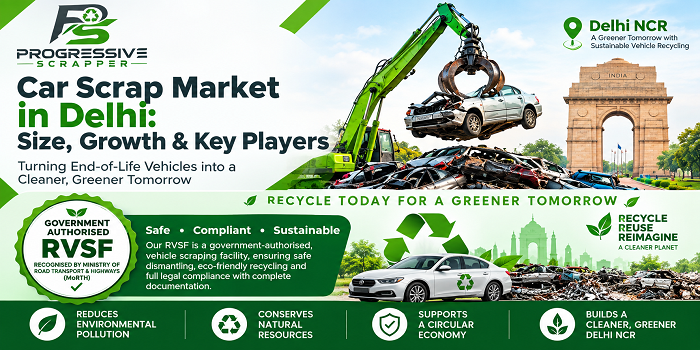
Delhi's roads tell a quiet story every single day. Somewhere between the traffic signals and the metro stations, thousands of old cars quietly reach the end of their journey. Some get towed away. Some sit abandoned in parking lots for years. And a growing number of them now head straight into a system that didn't really exist in any organized form a decade ago — the car scrap market in Delhi.
If you've ever wondered what actually happens to a car once it's declared too old to drive, or why you keep hearing about scrapping policies on the news, this piece breaks down exactly how this market works, how big it has become, and where it's headed next.
In simple terms, the car scrap market in Delhi refers to the entire ecosystem involved in taking end-of-life vehicles off the road and processing them — dismantling, recycling, and disposing of parts responsibly. This includes government-authorized facilities known as Registered Vehicle Scrapping Facilities, informal scrap dealers, metal recyclers, and everyone in between.
Delhi has one of the highest numbers of aging vehicles in the country. Lakhs of cars and two-wheelers have crossed the legal age limit — 15 years for petrol vehicles and 10 years for diesel ones — making them illegal to drive on city roads. That single fact alone has created enormous demand for a functioning, reliable scrapping system.
It's hard to put an exact number on how large the Delhi car scrapping market truly is, because a chunk of it still operates informally. But even a rough look tells you this is not a small industry. With millions of overage vehicles technically due for scrapping across the National Capital Region, and new ones added to that list every year, the volume of vehicles moving through this system is massive — and growing.
A few things have really pushed this market forward in recent years:
The Vehicle Scrappage Policy 2021 gave the entire industry a proper legal and financial framework. It introduced incentives for people who scrap old vehicles and buy new ones, which made scrapping far more attractive than simply letting a car rot in a parking lot.
Court orders and pollution control mandates have also played a huge role. Delhi's air quality crisis has repeatedly pushed authorities to crack down on old, polluting vehicles, which has directly fed into the scrap market's growth.
And then there's simple economics — as repair costs for older vehicles climb and resale value drops to almost nothing, more owners are realizing that scrapping isn't a last resort anymore. It's often the smarter financial decision.
For decades, informal scrapyards handled almost all vehicle scrapping in Delhi. Places like Mayapuri became synonymous with this kind of work — rows of dismantled cars, workers stripping vehicles by hand, and parts being resold with little to no documentation. It worked, in the sense that it got cars off the road, but it came with real problems: no proper environmental safeguards, no legal paperwork, and no protection for the vehicle owner if something went wrong later.
That picture has been changing steadily. The rise of government-authorized car scrap dealers has brought structure to something that used to be chaotic. These are facilities recognized by the Ministry of Road Transport and Highways, following approved processes for dismantling, depollution, and recycling. Owners now get proper documentation — a Certificate of Deposit and a Certificate of Vehicle Scrapping — which protects them legally and gives them proof that their vehicle was disposed of the right way.
This shift toward organized scrapping is arguably the biggest transformation in the vehicle scrapping industry Delhi has seen in years.
The organized side of the Delhi NCR car scrapping market now includes a number of established, authorized players handling everything from passenger cars to commercial fleets. These facilities typically offer doorstep pickup, transparent pricing based on the vehicle's weight and condition, and complete assistance with paperwork — something that was almost unheard of a decade ago.
Progressive Scrapper is one such RVSF Delhi NCR-based operation, offering fully compliant scrapping services across the region. But it's worth noting this is a genuinely growing space — more authorized facilities are opening every year to keep pace with demand, which is generally a good sign for anyone looking for a trustworthy, legal way to scrap their vehicle.
As India pushes harder toward electric mobility, expect the scrapping conversation to expand beyond just old petrol and diesel cars. There's growing talk around EV scrappage policy frameworks, battery recycling, and fresh incentives tied to trading in older vehicles for electric ones. This is still an evolving space, but it's clearly part of where things are heading.
The number of RVSFs in Delhi has been steadily increasing, and that trend is expected to continue. More competition among authorized facilities generally means better pricing, faster processing, and improved service for vehicle owners — which is good news for anyone who eventually needs to scrap a car.
If reading through all this has made you realize your own car might be due for scrapping, the good news is that the process today is far simpler than it used to be. Government-authorized facilities handle everything — inspection, fair valuation based on your car's condition and weight, free doorstep pickup, and complete documentation support so you're not left running between offices.
You also walk away with proper legal proof that your vehicle was scrapped responsibly, which matters more than most people realize until they actually need it. If you're in Delhi NCR and have an old, damaged, or non-functional vehicle sitting around, getting an instant quote from a trusted government-authorized scrapping facility like Progressive Scrappers is usually the easiest first step.
Yes, for vehicles that have crossed their legal age limit — 15 years for petrol and 10 years for diesel — driving or even parking them on public roads is not allowed.
The exact number keeps growing, but Delhi NCR now has multiple government-recognized facilities, a sharp rise from just a handful a few years ago.
Not entirely illegal, but it lacks the legal documentation and environmental compliance that authorized facilities provide, which can leave vehicle owners exposed to risk later.
You receive a Certificate of Deposit and eventually a Certificate of Vehicle Scrapping, both of which serve as legal proof that your vehicle has been responsibly disposed of.
Any vehicle owner in Delhi NCR can get their car scrapped, whether it's overage, damaged, non-functional, or simply no longer wanted — as long as it's done through a government-authorized facility to keep the process legal.
If your vehicle has an active loan or insurance policy, it's best to clear or transfer those first, since the scrapping process requires you to be the clear legal owner with proper documentation in hand.
We are a trusted vehicle scrapping and recycling company dedicated to safe dismantling, responsible metal recovery, and environmentally sustainable recycling solutions.
Gate No 1, B4/304 1st Floor, near Metro Station Keshav Puram, Tri Nagar, New Delhi, Delhi
Developed by Webquickindia.com
Share your details and your vehicle information. We will contact you with the next steps.