Have questions or need our services? Our team is ready to assist you with reliable solutions and prompt support. Contact us today to discuss your requirements.
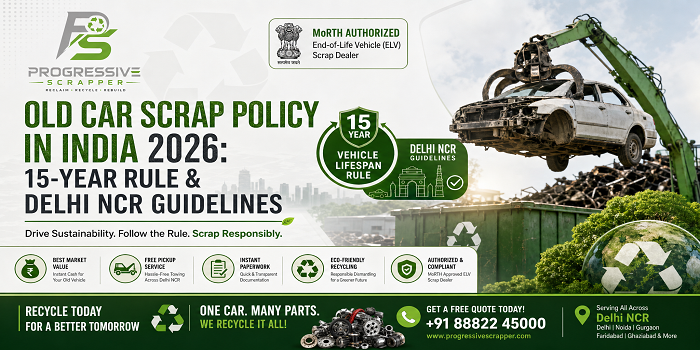
If you have an old car, chances are you might be wondering what will happen when your car reaches 10 years, 15 years, or more. Vehicle owners in general try to look up the old car scrap policy because they do not know whether they have to scrap the old car, use the old car, or even sell the old car to a scrap yard.
It is not always based on the age of the car.
There are certain things like vehicle registration, emission norms, vehicle fitness, and pollution norms that are considered while determining the end of an old car's life cycle. Especially in the case of Delhi NCR, there are certain measures that have been taken by the government in order to reduce vehicular pollution in the area.
This article covers everything about the old car scrap policy in India, the 15-year-old car problem, how long an average car can last, and what vehicle owners in Delhi NCR must know in 2026.
The vehicle scrapping policy for old cars is a part of the general vehicle scrapping policy of India for End-of-Life Vehicles (ELVs).
Vehicle scrapping involves not only the removal of old vehicles from the roads but also the proper dismantling of vehicles and their recycling.
As per the vehicle scrapping policy in India, an ELV (End-of-Life Vehicle) refers to any vehicle that has expired for registration or has been declared unfit, or whose registration is cancelled (subject to court orders, or voluntarily declared as a waste vehicle by its owner.
It is significant to note here that old cars are not necessarily ELVs.
An old car does not automatically imply that it should be scrapped the very next day.
One of the most frequently asked queries is how many years a car can be used in India.
There isn't any such law that requires the mandatory scrapping of all private cars at the end of one particular period of time.
Depending on the following factors, the situation may vary:
Category of the vehicle
Renewal conditions applicable
Emission category
Condition of fitness
Certificate of pollution
Restrictions, if any, in any state/local laws or court orders
Fuel used
Status of registration
End of useful life of the vehicle
Hence, if your car is nearing 15 years old, do not take any action simply on the basis of the manufacturing/registration year of your car.
Find out the status of registration, emission category, and conditions applicable in your jurisdiction.
This is one of the popular myths regarding the rule of 15-year-old car scrapping.
It is assumed that all cars using petrol are required to be compulsorily scrapped after reaching the age of 15 years. But the existing situation in the Delhi NCR region is far from being so.
According to the amendment introduced by the Supreme Court into the previous decision made on 17th December 2025, no coercive actions could be taken against owners of BS-IV and its further versions of vehicles because of the fact that diesel vehicles exceeded the age of 10 years and petrol ones exceeded the age of 15 years.
As one can see, owners of vehicles cannot treat the following phrase "15 years means mandatory scrapping of all petrol vehicles" as an adequate reflection of the current legal reality.
However, aged vehicles can still be subjected to some other laws and regulations concerning, for instance, pollution norms and so on.
Therefore, before scrapping your old car, it would be better to check out its condition and not simply take the above-mentioned phrase into account according to the age of your vehicle.
The Delhi National Capital Region needs special attention as extra air quality control measures are available in this region.
Older restrictions regarding the use of old versions of diesel/petrol cars are still important concerns despite the change in law due to government directions and decisions made by the Supreme Court.
There is another important concern related to 2026 regarding Pollution Under Control certificates.
The Direction No. 101 of the CAQM was enacted on 15 May 2026 with respect to the matter of fuelling of vehicles without a valid PUCC.
It talks about dispensing fuel within the NCR region as on 1st October 2026 after issuing a valid PUCC.
Clearly, it becomes vital for the owners of older vehicles to have a valid PUCC.
Thus, if you own an old vehicle in Delhi NCR, then apart from the age of your vehicle, the following questions need to be addressed:
Is the RC valid?
What is the BS emission category of the vehicle?
Is the PUCC valid?
Are there any other local restrictions?
Is the vehicle worth retaining?
Should the vehicle be scrapped?
The concept of car life in India has to be seen from two perspectives: legal and practical.
Although the car may have been running efficiently for several years, it doesn’t mean that it was running without any limitations.
There are several factors that determine the efficiency of an old car.
Age is a crucial factor in relation to different vehicle laws, especially in jurisdictions with stricter pollution controls.
The Bharat Stage emissions standard of the vehicle will matter significantly to those residing in Delhi NCR.
A car owner needs to monitor the status of the validity of his/her vehicle’s registration.
A valid PUCC shows adherence to pollution control standards.
An aged car that needs frequent repairs might not be worth it financially even if it is repairable.
The requirements may change according to the location where the vehicle has been registered as well as the area it is driven in.
That is precisely the reason why the question “how long can I keep my car?” cannot be answered easily.
Age is not the only factor that makes the need for scrapping old cars arise.
At times, it makes perfect sense to think about scrapping from both the financial and practical standpoints.
This is especially true if the car:
Needs costly repairs every year
Has sustained damage in an accident
Needs costly repairs to the engine and transmission
Needs hard-to-get parts
Becomes uneconomical to keep
Has significant safety issues
Cannot meet relevant fitness or emissions standards
Has registration-related restrictions that render further use unreasonable
Has truly become obsolete
Thus, in cases when an old car needs costly repair work but is worth little, spending even more on it does not seem like a good idea.
It is better to think about scrapping in such situations.
If you choose to scrap your car, please do not think only about selling it to the highest bidder.
The registered process of vehicle scrapping allows for Registered Vehicle Scrapping Facilities (RVSF). The RVSF is capable of registering appropriate VAHAN entries and issuing various certificates like the Certificate of Deposit and Certificate of Scrapping.
The process includes:
This can be provided by the owner with respect to the vehicle that needs to be scrapped.
These papers need to be verified for the purpose of checking the ownership of the vehicle and other facts.
There could be testing of the vehicle before its acceptance for scrapping.
This is done based on the required scrapping process.
Certificates and other information are issued after the process of scrapping.
The V-Scrap official site provides various kinds of services related to vehicle scrapping.
But before planning the scrap car process, make sure that you have all the documents for your car handy.
According to the vehicle, the documents will be as follows:
Registration Certificate
Documents regarding the owner
Documents regarding vehicle registration
Documents regarding insurance
Pollution certificate (if needed)
Documents regarding financier/ hypothecation (if applicable)
Any other documents required by the relevant authority/ facility
In case the vehicle has any kind of pending loan or hypothecation, it is always better to clear it off.
Parivahan documents regarding some services of the vehicle are RC, Insurance, and PUCC.
There is a difference between selling an unwanted car to an informal scrap buyer and completing the vehicle's disposal through a registered facility.
A registered facility operates within the applicable vehicle-scrapping framework and can support the required documentation and VAHAN-related process.
The official CPCB guidance notes that Registered Vehicle Scrapping Facilities are authorized to make appropriate VAHAN entries for scrapping and issue Certificates of Deposit and Certificates of Scrapping.
For vehicle owners, this can help with:
Proper documentation
Traceable vehicle disposal
Responsible dismantling
Recycling of vehicle materials
Better compliance with the formal scrapping process
If you are searching for a car scrap dealer in Delhi NCR, verify whether the facility follows the applicable registered scrapping process before handing over your vehicle.
In situations where the owners reside in Delhi, Noida, Ghaziabad, Gurugram, and Faridabad, it becomes mandatory to consider not only the policy on vehicle scrappage by the national government but also the policy for the NCR region on pollution control.
Asking, "Is my vehicle 15 years old?" is not sufficient.
Instead, it needs to be thought through from "the entire scenario":
Vehicle age + emission standard + registration + PUCC + relevant local policy + vehicle condition
This gives you a much better platform to decide whether your old vehicle should continue to run, be sold, or scrapped.
Progressive Scrapper serves customers from all over Delhi and the NCR Region for scrapping their old vehicles.
There is no requirement for a vehicle owner to wait for there being any regulatory problem before considering scrapping.
Some of the reasons why you can decide to scrap your vehicle include:
- The vehicle requires very expensive repairs
- You are buying another new car
- The car has been damaged
- You do not require the vehicle anymore
- The vehicle is difficult to maintain
- You would like to dispose of the vehicle properly
There are some official V-Scrap vehicle owner services in India.
The main thing is to follow the legal procedures for disposing of the vehicle.
This existing rule on vehicle scrapping has to be reviewed in such a way that it is not seen as a simple rule depending only on the age of the vehicle.
As a vehicle owner, it is better for you to check the registration, emissions type, PUCC, condition of the vehicle, and other laws related to the area where you want to drive your vehicle.
This becomes even more essential in the case of Delhi NCR, as the measures for pollution control are changing in the area. 2026 CAQM PUCC guideline is another reason why vehicle owners should update their pollution control documents.
If you have a vehicle that is no longer worth running or has reached the end of its lifespan, you can use the vehicle scrapping facility to make things systematic.
Through Progressive Scrapper, vehicle owners can benefit from old vehicle and end-of-life scrapping facilities systematically.
All vehicles cannot be judged just based on their age. For example, in the case of Delhi NCR, the Supreme Court order passed in December 2025 has modified the punitive measures that were applicable to vehicles that were BS-IV and higher just based on the 10-year rule for diesel and petrol cars.
However, there is no specific age that will satisfy this question for all vehicles and places. Registration age, emission standards, fitness age, PUCC, and state law should all be considered.
This is the larger context in which End-of-Life Vehicles are identified and managed via scrap and recycling mechanisms. The relevant legislation relates to scrapyard facilities and End-of-Life Vehicle management.
Yes, India has its V-Scrap program that offers vehicle owners the ability to undergo a formal vehicle scrapping process.
The CAQM Direction No. 101 issued on 15th May 2026 suggests restricting the supply of fuel for the vehicles having a valid PUCC from 1st October 2026.
We are a trusted vehicle scrapping and recycling company dedicated to safe dismantling, responsible metal recovery, and environmentally sustainable recycling solutions.
Gate No 1, B4/304 1st Floor, near Metro Station Keshav Puram, Tri Nagar, New Delhi, Delhi
Developed by Webquickindia.com
Share your details and your vehicle information. We will contact you with the next steps.