
Have questions or need our services? Our team is ready to assist you with reliable solutions and prompt support. Contact us today to discuss your requirements.
Written by [Devansh], [Employee], Progressive Scrappers | Reviewed by Management
| Last updated: October 2026
If you have ever found yourself looking at your RC book and wondering what BS means there, then you’re definitely not alone. Every winter, car owners in Delhi ask themselves the same apprehensive question: Is my car permitted to be on the roads today? Knowing the differences between BS3, BS4, and BS6 will help you answer it the fastest. This guide is here to show you all the ins and outs of the BS norms and how to deal with the ban in Delhi.
Quick answer: BS stands for Bharat Stage, India's emission standard. BS3 is the oldest and most polluting, BS4 sits in the middle, and BS6, mandatory since April 2020, is the cleanest. In Delhi, the older the norm, the tighter the restrictions.
The Bharat Stage norms are emission norms laid down by the Government of India for regulating the emissions of dangerous pollutants like nitrogen oxides, particulate matter, and carbon monoxide. The standards are similar to the Euro Norms followed in Europe but have been adapted as per the Indian scenario of fuels and roads. The stricter norms are enforced at each successive stage, and better fuel is also required at the same time.
One may be curious about the skipping of BS5 by India. It was decided by the Indian government in 2016 to shift from BS4 to BS6 without including BS5. The move from BS4 to BS6 was made in April 2020, which was quite before the scheduled time. This is the reason why the difference between BS4 and BS6 is far greater than between BS3 and BS4.
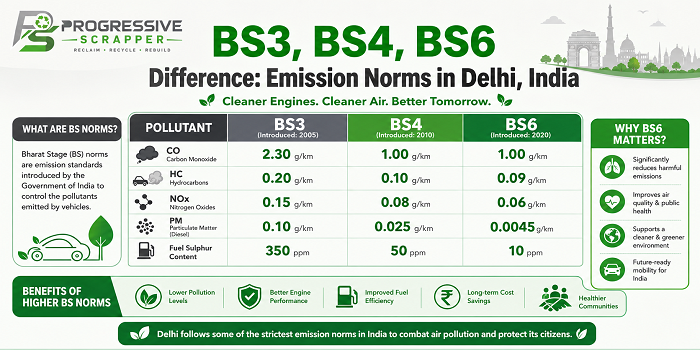
Here is a simple side-by-side look at the BS3 vs BS4 vs BS6 emission standards.
|
Feature |
BS3 |
BS4 |
BS6 |
|
Rollout |
From 2005, nationwide by 2010 |
From 2010, nationwide by 2017 |
From April 2020 |
|
Fuel sulphur limit |
350 ppm |
50 ppm |
10 ppm |
|
Pollution level |
Highest |
Moderate |
Lowest |
|
Delhi status |
Most restricted |
Diesel restricted during GRAP |
Generally allowed |
Rollout dates varied by city, so never judge a vehicle by its manufacturing year alone.
However, the most notable change was that of the quality of the fuel. The amount of sulphur in the fuel went from 350 ppm to 50 ppm.
This is where the leap came. Sulphur content fell to 10 ppm, particulate filters were added to diesel cars, and tests were conducted in real driving conditions rather than lab cycles only. The commonly mentioned numbers state that BS6 diesel engines release about 80% fewer particulates and 70% fewer nitrogen oxides than BS4 engines.
The BS6 standards themselves were enhanced in April 2023 by introducing Phase 2. The enhancements included the introduction of real driving emissions and advanced on-board diagnostics, which continue to monitor the vehicle's emissions during driving. The car you will be purchasing now is most likely a BS6 Phase 2 one.
Start with your RC book, which often mentions the emission norm. If it doesn't, look for the manufacturer's label near the driver's door or check the owner's manual. A dealer or service centre can also confirm it from your chassis number. You can verify registration details on the Parivahan portal too. Still unsure? Send us a photo of your RC, and we will tell you the norm for free.
GRAP, the Graded Response Action Plan, is Delhi-NCR's emergency pollution playbook, managed by the Commission for Air Quality Management (CAQM). Restrictions tighten as the Air Quality Index (AQI) worsens.
|
GRAP stage |
AQI range |
Air quality |
Key vehicle-related curbs |
|
Stage I |
201–300 |
Poor |
Stricter PUC checks and action on over-age vehicles, plus dust control |
|
Stage II |
301–400 |
Very poor |
Higher parking fees, diesel generator curbs, push for public transport |
|
Stage III |
401–450 |
Severe |
BS3 petrol and BS4 diesel four-wheelers off the road; non-essential construction halted |
|
Stage IV |
Above 450 |
Severe+ |
Entry of most trucks stopped (CNG, LNG, electric, BS6 diesel and essential goods exempt) |
These measures are updated by CAQM from time to time; hence, always refer to its latest order. One thing to remember here is that each subsequent stage builds on the previous one, and Stage III is the stage that impacts old private vehicles.
The BS3 category gets the most stringent treatment in the city. During “severe” levels of air pollution, GRAP Stage III prohibits BS3 petrol cars in the entire NCR region, and the ban remains in force until the air pollution levels improve. Challans for violations have reportedly included fines of up to Rs 20,000.
There is a second layer. In December 2025, the Supreme Court modified its earlier order so that authorities can still act against end-of-life vehicles below BS4. So the BS3 vehicle scrapping rules in Delhi lead to a practical conclusion: if your BS3 vehicle is old and barely used, scrapping it through a registered facility is usually less stressful than dealing with restrictions every winter.
Owners of BS4 vehicles fall in an intermediate category. While GRAP Stage III prohibits the use of BS4 diesel four-wheelers on roads, the Supreme Court order clearly states that no coercive measures can be adopted against BS4 and newer vehicles based solely on their age exceeding 10 years for diesel and 15 years for petrol.
In short, the BS4 vehicle scrapping rules don't currently force you to scrap by age alone. Court orders can change, though, so confirm the latest position before you decide.
GRAP restrictions don’t apply to BS6 vehicles, nor does any sort of age-related restriction, which means that BS6 owners do not need to scrap their vehicles in normal circumstances. This is done generally because of a very serious incident involving the vehicle, flooding or a fire, or simply a changeover to an EV.
The BS6 vehicle scrapping process follows the same legal route as any other vehicle:
Take the vehicle to an Authorised Vehicle Scrapping Facility (RVSF) for inspection and document verification.
Hand over the vehicle, which is then dismantled and its registration cancelled.
Receive your digital Certificate of Deposit (CoD).
That’s not quite accurate. The prohibition of BS3 petrol and BS4 diesel under the GRAP Stage III is applicable only to four-wheelers, so two-wheelers are not covered by that prohibition. However, two-wheelers may fall under age-based restrictions and also have to take the same route for RVSF as four-wheelers if the decision to scrap the vehicle is taken.
Commercial vehicles are on another wavelength. Light commercial vehicles run on diesel fuel and registered outside of Delhi cannot be allowed into Delhi under GRAP Stage III. Goods vehicles registered outside of Delhi also have stricter entry criteria. The direction of CAQM gave limited time to BS4 goods vehicles to run up to 31st October 2026, so transporters need to check with CAQM and the Delhi Transport Department on the current scenario.
Delhi doesn’t do things alone. The GRAP is implemented for Delhi, Gurugram, Faridabad, Ghaziabad, Noida, and Greater Noida simultaneously. But the process of registration and other things related to it come under the jurisdiction of the respective states’ transport departments; thus, there may be slight variations.
Three habits help every owner. Check the current GRAP stage during winter, keep a valid PUC certificate handy, and keep your RC and ID documents ready. Knowing the vehicle scrappage rules in Delhi NCR before a restriction hits saves a lot of last-minute scrambling. For the national framework, the Ministry of Road Transport and Highways publishes the scrappage policy and rules.
|
Your vehicle |
Can it run in Delhi during GRAP Stage III? |
Age-based action now? |
Should you think about scrapping? |
|
BS3 petrol |
No |
Yes, can face action |
Strongly, if it is old or rarely used |
|
BS4 petrol |
Yes, not covered by the Stage III ban |
No coercive steps on age alone |
Not compulsory; your choice |
|
BS4 diesel |
No |
No coercive steps on age alone |
Worth considering if you drive daily in winter |
|
BS6 |
Yes |
No |
Only after damage, lapsed papers, or by choice |
Treat this table as a starting point, not legal advice. Orders change, so verify before acting.
Only a registered workshop is eligible for the issuance of a Certificate of Deposit. The said document will be useful in seeking exemption from paying a registration fee for the new vehicle. In the national scrappage scheme, states can provide an exemption in road taxes up to 25 percent for new private vehicles. This will nullify your previous registration.
At Progressive Scrappers, we guide owners through the Vahan paperwork, explain the scrap value before pickup, and handle the Certificate of Deposit. Our authorisation details are listed on our About page. If you need help with an older vehicle, you can read about our BS3, BS4, and BS6 vehicle scrap service in Delhi.
The differences between BS3, BS4, and BS6 boil down to clean fuel, improved engines, and stringent norms at every level. For those residing in Delhi, this factor will determine the permissible number of runs for your car. Be aware of your norms, monitor GRAP changes, and in case of scrapping, select an authorized center.
Sources: CAQM, Ministry of Road Transport and Highways, Parivahan/Vahan portal, Supreme Court order of December 2025.
BS3 is the oldest and most polluting norm. BS4 uses cleaner fuel (50 ppm sulphur). BS6 is the cleanest, with 10 ppm sulphur, and has been mandatory since April 2020.
The government chose to leap from BS4 straight to BS6 in 2016 to tackle pollution faster, and BS6 arrived in April 2020.
There is no permanent ban. BS4 diesel four-wheelers are barred only while GRAP Stage III is in force.
Yes. After an eligibility check, you can scrap it through a registered facility, commonly after an accident, flood, or fire.
Check your RC book, the manufacturer's label, or ask your dealer or service centre.
GRAP restrictions apply across the NCR together, but registration and paperwork are handled by each state's transport department.
We are a trusted vehicle scrapping and recycling company dedicated to safe dismantling, responsible metal recovery, and environmentally sustainable recycling solutions.
Gate No 1, B4/304 1st Floor, near Metro Station Keshav Puram, Tri Nagar, New Delhi, Delhi
Developed by Webquickindia.com
Share your details and your vehicle information. We will contact you with the next steps.