
Have questions or need our services? Our team is ready to assist you with reliable solutions and prompt support. Contact us today to discuss your requirements.
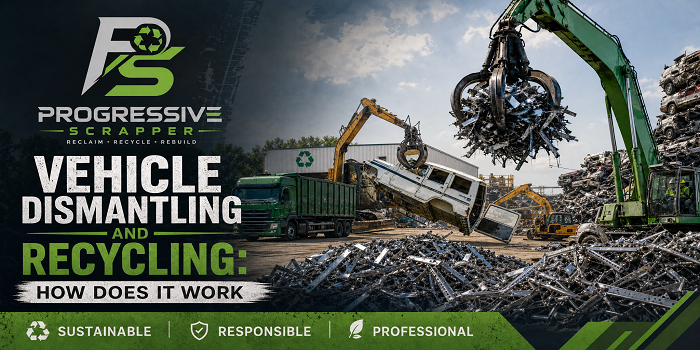
In the event that the lifespan of a car expires, abandoning it at a certain point in time or dumping it at an unstructured scrapyard may not be the best method for disposing of the car. Vehicle dismantling and Recycling involves the process by which, through inspection, de-pollution, dismantling, segregation, and processing, valuable materials may be recovered.
At Progressive Scrappers, the focus of the organization is on the organized vehicle dismantling and recycling process. End-of-life vehicles may serve to save valuable materials, avoid wastage, and promote resource sustainability. Being aware of the process will aid car owners to make the right decisions in regard to their cars when they are no longer usable.
Dismantling of the vehicle refers to the process of taking apart the vehicle that is no longer usable and separating the different parts of the vehicle. Prior to the process of dismantling, there is an assessment of the vehicle, and documentation is checked. The parts of the vehicle which are considered suitable for reuse or recycling are then separated from other materials that are going to be recycled.
The recycling of vehicles occurs after the dismantling process and entails the sorting and recycling of materials including steel, aluminum, copper, plastic, rubber and glass. Rather than looking at the end-of-life vehicle as one big lump of waste, the process of separation allows for the recycling of different materials based on their individual properties.
A car consists of far more parts than just metal. It has fluids, batteries, tires, plastic, glass, and electronics, among other things. If a used car is not handled the right way, then those parts may be improperly disposed of.
Proper disassembly will lead to several benefits:
Systematic deconstruction assists in ensuring that various parts of the vehicle are sorted out rather than being disposed of together.
Metals and certain elements can be separated and sent through their respective recycling process.
This will help prevent excessive generation of automotive waste and enhance the handling of materials from scrapped cars.
The procedure may vary from one vehicle to another and even from one place to another, but there are basically a number of steps in proper dismantling.
It begins with receiving and assessing the vehicle. The vehicle might have been detected and assessed before disassembly of the vehicle.
The initial assessment will enable the manager to know the need for additional processing. It may also highlight the components/materials that will require special attention in future processing stages.
Good record-keeping is an important aspect in the responsible end-of-life management of vehicles.
Before the commencement of any major dismantling, it would be vital to ensure that the appropriate disposal of the materials that could pose some risks to people's health is performed first.
This is because they may include fluids like fuel, oil, coolant, brake fluids, and various other automotive fluids.
It is essential to avoid leakage and ensure the proper disposal of such fluids, which should be disposed of in a particular way.
This also includes batteries and various other components that require particular disposal methods.
After thorough preparation of the vehicle, several parts can be removed one by one from the car.
These parts can be tires, batteries, glass, electronic components, interior components, and mechanical components. Some of the parts may even be salvageable. The process of stripping will ensure that different components are separated.
When the necessary parts have been removed from the car, the car chassis is then dismantled, and the materials are segregated.
Materials may be classified broadly as ferrous materials, such as steel; non-ferrous materials, including aluminum and copper; plastics; rubber; and glass.
Segregation of materials increases the efficiency of processing.
After segregation, the recyclable materials may go through further processing. Metal materials are viewed as the most valuable because they are recyclable and can become secondary raw materials.
For example, metals such as steel and aluminium can go through the process of recycling instead of obtaining raw materials every time manufacturing starts. There is a possibility to process other materials depending on their peculiarities and ways of recycling.
The key aim is to use as much material as possible, taking into consideration the particular characteristics of its processing.
There are numerous materials found in present-day vehicles, and these materials may be recycled.
Steel constitutes a considerable proportion of a normal car and can easily be recycled. There are also other materials such as aluminum and copper that can be recycled.
This process helps to reduce the dependence on mining new sources of metal.
Plastics, rubber, glass, and other non-metallic components can also be found in cars. These need special handling, depending on their nature and condition.
The tyres and rubber components can be stripped from the vehicle itself, while the glass must go to recovery centres.
It is imperative that there is correct handling of batteries and electrical parts, along with certain parts of vehicles. Though there are parts that can be recycled or reused, there are parts that require special handling.
Once the process of taking apart is completed, the segregated materials and parts do not all proceed on the same route.
Usable parts, if any, may be segregated for reuse purposes. Metals and other recyclable materials may be segregated for their corresponding recycling process. Materials needing special treatment may be sorted out for that particular purpose.
Such segregation is one of the prime advantages of processing in an organized manner. Rather than viewing the vehicle as one unit of waste, the materials in it can be segregated for handling purposes.
Not all the time are vehicle stripping and informal disposal synonymous processes.
Vehicle stripping is an organized process characterized by the systematic stripping of components, fluid management, material separation, and extraction of recyclable materials. This process is also characterized by more documentation and processing of vehicles.
The traditional informal processes vary from person to person, and therefore it is advisable for car owners to go for an organized process of vehicle stripping and processing.
It should be noted that the difference lies mainly in the processing process.
Proper recycling of end-of-life vehicles can result in a number of advantages for the environment.
Firstly, recycling of metal components will help reduce the quantity of waste generated. Moreover, the recycled metal can be used as secondary raw materials, thus saving on their extraction.
Secondly, the process of proper disassembly presupposes sorting of the substances that cannot be disposed of without caution.
Finally, recycling makes it possible to use the principles of the circular economy, which implies that the materials extracted from the scrap vehicle will be used again and not simply be thrown away.
Therefore, proper management of end-of-life vehicles is an important part of sustainable resource management.
Facility selection is among the factors to consider during the process of disposing of an end-of-life vehicle. The facility is likely to provide services for verification, dismantling, separation, and recycling of the vehicle.
The owner of the vehicle should consider factors such as authorization, documentation, processing procedure, environmental practices, and handling of end-of-life vehicles by the facility.
Progressive Scrappers provides a structured disassembly and recycling program to facilitate the process of end-of-life vehicle processing.
Vehicle Dismantling and Recycling is not merely the act of taking apart an outdated vehicle. It is a well-defined process that entails inspection, decontamination, parts extraction, separation of materials, and recycling. Done properly, it helps recover valuable materials, cut back automobile pollution, and facilitate more efficient disposal of vehicles.
When it comes to the process of disposing of an automobile at the end of its useful life, the selection of an appropriate and authorized facility is a crucial choice for the owner of such a vehicle in India. Progressive Scrappers aims to provide responsible solutions in terms of vehicle dismantling and recycling.
Vehicle disassembly is the process of deconstructing a decommissioned vehicle to allow its components and materials to be reused, recovered, recycled, or treated.
In the recycling process, materials collected after the disassembly of the automobile are sorted and assigned to their respective processing paths. The materials include metals, plastics, glass, rubber, among others.
Examples of commonly recyclable items include steel, aluminum, copper, plastics, glass, rubber, and some other materials. Depending on the item being recycled, the recycling process is determined.
Yes. Scrapping refers to the disposal of an obsolete car, while systematic disassembly consists of taking apart the vehicle, handling fluids, separating materials, and reclaiming recyclable products.
An authorized facility can help provide a systematic way to verify vehicles, dismantle them, segregate materials, and recycle them. This will help the owner of the vehicle be sure that his end-of-life vehicle is properly handled.
We are a trusted vehicle scrapping and recycling company dedicated to safe dismantling, responsible metal recovery, and environmentally sustainable recycling solutions.
Gate No 1, B4/304 1st Floor, near Metro Station Keshav Puram, Tri Nagar, New Delhi, Delhi
Developed by Webquickindia.com
Share your details and your vehicle information. We will contact you with the next steps.