Have questions or need our services? Our team is ready to assist you with reliable solutions and prompt support. Contact us today to discuss your requirements.
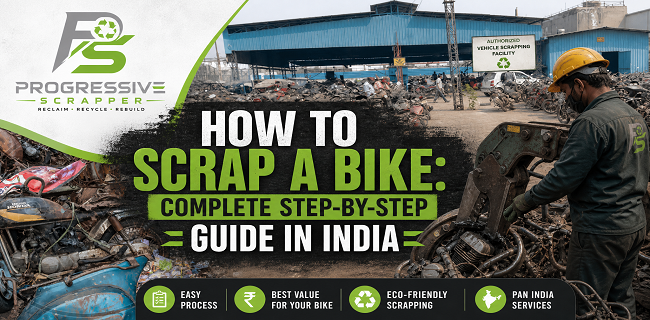
As the age of the motorcycle increases, its cost of maintenance will rise. It can become risky to ride or non-compliant with government guidelines. The question arises on how to scrap a bike. A good choice to make is to choose a legal and eco-friendly way to scrap your bike at a facility authorized by the government. Your motorcycle will be broken down safely and responsibly, and the right documents will be prepared.
No matter if your bike is too old or damaged from an accident and isn’t worth repairing or needs too many funds to be fixed, knowing the process of bike scrapping will help you make the decision. In this guide, you will find all the information you need about the whole process of bike scrapping.
Scrapping a bike refers to disposing of the unusable or old motorcycle in a manner that it is taken off the roads via an authorized recycling process. The motorcycle cannot be dumped carelessly on roads, nor can it be sold to any unscrupulous scrap metal dealers; it has to be scrapped in accordance with the government guidelines.
Knowing how to scrap a bike is important because it helps avoid legal troubles in the future and contributes to responsible recycling of the vehicle. This is carried out at a government-authorized vehicle recycling facility through a proper dismantling process.
It becomes an End-of-Life Vehicle (ELV) when the vehicle cannot be used anymore for safety, economic reasons, and practicality. There are many vehicles, and each one of them is unique, but there are certain circumstances under which scrapping would become the best option.
These are:
The repair costs exceed its market price.
The vehicle is seriously damaged by accidents.
It faces serious problems in terms of structure.
It has not been used for a long period of time.
The vehicle does not meet all regulations.
Under such circumstances, opting for a proper bike scrapping process becomes the best course of action.
Most owners keep repairing their vehicles without understanding that disposing of the vehicle may be the best course of action. Old motorcycles tend to need frequent maintenance, use up more fuel, and do not offer the required safety and reliability as a vehicle on the road.
Disposing of your old motorcycle will help promote recycling. There are different kinds of materials that can be recycled and reused, such as steel, aluminum, copper, rubber, plastics, and many more.
It is as crucial to know the time when it is necessary to dispose of your motorcycle as it is to understand how to scrap a bike. Being late might result in increasing the expenses of maintaining the vehicle.
When your bike suffers from constant malfunctions despite constant maintenance, then it is an indication that the motorcycle has worn out. Repeated engine breakdowns, electrical problems, or high rates of oil leaking may be clear indications that further repair costs are not worthwhile.
With age, parts for motorcycles become difficult to obtain and costly. If one is spending substantial money periodically to keep the motorcycle in operational condition, then dismantling the motorcycle through an official channel may be a cheaper option.
Some older motorcycles could need more checks or fail to satisfy the existing regulations. Rather than spending more money on repairs, they prefer to dispose of their motorcycles through the government-licensed agency.
In the event of a major accident with a motorbike, the bike may have structural damage that cannot be seen but can endanger the safety of the rider even after repair. It is important for such a bike to be scrapped.
Before beginning the process of scrapping the bike, collect all the required documents. Documentation is important to establish ownership and will help ensure the scrapping process is in accordance with the law.
The Registration Certificate is the foremost document needed for the scrapping process of a motorcycle. This document proves that you are the owner of the motorcycle.
In case the Registration Certificate is not available, then you need to consult the authorized scrapping center about alternative documents.
An official ID proof issued by the government is necessary in order to prove one’s identity.
A document that proves the address is a way to prove the information about the residency of the person. The documents could be Aadhaar Card, Passport, Driving Licence, and some other government document.
Though having an active insurance cover may not necessarily be compulsory, presenting the available insurance papers can make the documentation process easier.
In case the motorcycle is being financed or there is an outstanding loan on the bike, then an NOC from the finance company might be necessary before you can scrap the motorcycle. This will help avoid future issues regarding ownership and finances.
Making these documents beforehand saves time and makes the whole process easy for the authorized scrapping facility.
With the documents sorted out, you then need to understand how the scrapping process for a bike really works. The right process guarantees that your bike is scrapped in line with all governmental and environmental laws.
The first step, which is also the most crucial one, is to choose a government-authorized two-wheeler scrapping facility. These facilities are authorized because they perform proper scrapping methods, keep proper records, and assist customers in every step of the scrapping process.
Also, choosing such an authorized facility will ensure that the recyclable components are handled properly and all the legalities involved are fulfilled.
After making contact with the scrapping yard, an inspection of the motorcycle is scheduled in order to determine its condition. This step involves identifying the motorcycle, checking the submitted documents, and examining the various elements that might affect the value of the motorcycle when it is scrapped.
The inspection process also ensures that the motorcycle meets the requirements for scrapping.
After inspection of your bike, the scrapping plant will cross-check all documents submitted by you to ascertain ownership and verify that the bike qualifies for scrapping. Documents that will be checked include your Registration Certificate (RC), identity proof, address proof, among others that may be needed depending on whether the bike was owned by you or a financial institution.
If the motorcycle successfully passes through the process of validation, then it is transported to the disassembling area, where experienced people disassemble the parts that can be reused and separate out the materials that need to be recycled. Steel, aluminum, copper, rubber, plastic, and batteries will all be managed properly, whereas the hazardous items will be disposed of properly.
Opting for an authorized vehicle scrapping company will ensure that the motorcycle is disassembled in an environmentally friendly manner.
One of the most crucial phases after dismantling is that of RC cancellation. RC cancellation helps to remove the vehicle officially from the list of vehicles maintained by the government, and no legal or ownership problems will arise in the future. Failure to do so may cause complications if the vehicle is used in an illegal manner after its disposal.
After scrapping the bike and completing all the necessary formalities, the owner is issued with a Certificate of Deposit (CoD). The document acts as evidence that the bike has been scrapped at an authorized location. Depending on the government rules, the CoD could also be useful for claiming benefits when buying a new vehicle.
Some people are often curious about what should be done if their original registration certificate is lost or damaged. Sometimes, there might be an authorized scrapping facility that can help you out in verifying your bike. The method will depend on the law and documents that you have.
It’s always better not to contact any unauthorized scrapping dealers when you are unable to find your RC. Rather, you need to visit a government-approved bike scrapping center to know the right legal process. You will be guided about the documents that are needed.
Perhaps, one of the first concerns regarding scrapping a bicycle pertains to how the ultimate value is computed. There is no standard price as it depends on a number of considerations.
A vehicle with reusable parts will always command a greater value than a vehicle that has undergone serious damage or stripping.
The weight and value of recyclable metals have a major bearing on the scrapping value of motorcycles. Steel, aluminium, copper, among others, are measured during the inspection.
Famous makes and models of motorcycles can also be valuable if they are composed of parts that can be recycled easily.
Scrap metal prices vary according to market forces. Therefore, there is a possibility that the price of your motorcycle will change from time to time.
Engines, alloy wheels, and other reusable parts can add to the total value.
Selecting a government-authorized vehicle scrapping facility offers numerous benefits when compared to selling your motorcycle to an unauthorized scrap dealer.
Selecting a government-authorized vehicle scrapping facility offers numerous benefits when compared to selling your motorcycle to an unauthorized scrap dealer.
The professional removal procedure allows for salvaging useful materials and proper handling of dangerous waste.
All procedures in the scrap motorcycle cycle are recorded to ensure the legal disposal of the motorcycle.
Many authorized facilities facilitate the completion of the process by the consumers for canceling the RC through the reduction of paperwork.
Your motorcycle will be disassembled by the experts through proper recycling techniques.
Many people wonder what will happen after the vehicle is turned in. At an authorized site, the bike is recycled through an efficient process to recover resources.
After the careful disassembly of the motorcycle, the parts that can be reused are determined before the recycling process starts.
The parts that qualify based on certain criteria may be reused where necessary in order to minimize wastage.
Steel, aluminium, and copper, among other metals, are sorted out and recycled for use in future production processes.
Materials that need special handling, such as fluids, batteries, and tyres, are disposed of in a manner that adheres to environmental guidelines to ensure proper disposal.
Some simple steps that you could take would prevent any complications during the scrapping procedure of the bicycle.
Using the services of an unauthorized scrap dealer rather than an authorized one.
Filing in documents that do not meet the required criteria.
Not going through the RC cancellation procedure post scrapping of the bike.
Making payments without having the right knowledge about how scrap value is determined.
Not collecting the Certificate of Deposit (CoD) post scrapping of the bike.
Taking the time to follow the correct process helps ensure legal compliance and provides peace of mind.
Knowing the procedure for scrapping your bike is very necessary if you intend to scrap a bike that is no longer usable. The process involves document collection and verification, disassembly, RC cancellation, and obtaining the Certificate of Deposit – all these steps contribute significantly to making the process a legal one.
Select Progressive Scrapper, a government-authorized facility that makes sure that your bike is properly scrapped in line with the accepted standards of scrapping and contributes to the conservation of the environment, in addition to making the entire process of scrapping well documented. If your bike has come to the end of its life, then scrapping your bike will be the best way out.
The legal way to dispose of a bike would be to approach an authorized scrapping center for vehicles, give all the documentation, verify, and get the Registration Certificate canceled once the bike is disposed of.
In terms of legality, the correct process would be to visit the official center for disposing of vehicles, provide all the necessary documents, and confirm and get the Registration Certificate canceled upon disposal of the bike.
In case the original RC is not available, you should seek help from a government-approved vehicle scrapping facility. In some cases, additional proof may be required.
Factors that determine the worth of the motorcycle include its condition, weight of the metal, reusable parts, make and model, and the market value of the recyclable material.
Legal compliance, environmentally friendly recycling, proper documentation, help with RC cancellation, and correct disposal of dangerous items are assured by a government-approved facility.
We are a trusted vehicle scrapping and recycling company dedicated to safe dismantling, responsible metal recovery, and environmentally sustainable recycling solutions.
Gate No 1, B4/304 1st Floor, near Metro Station Keshav Puram, Tri Nagar, New Delhi, Delhi
Developed by Webquickindia.com
Share your details and your vehicle information. We will contact you with the next steps.