Have questions or need our services? Our team is ready to assist you with reliable solutions and prompt support. Contact us today to discuss your requirements.
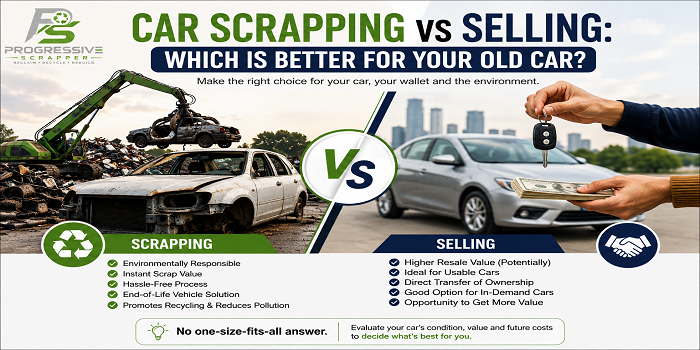
As one approaches the stage where maintaining their aging car becomes costly, there arises an interesting dilemma for the owner to decide – whether to sell the car or to scrap it? This decision is based on various criteria like the age of the car, condition of the car, demand for such used cars, cost of repair, legality of the car, and lastly the scrap value. Car scrapping vs selling will help you to make the best decision regarding your car.
If you consider selling the car, then it means that the car in question is still roadworthy and in good shape with some resale demand in the used car market. Otherwise, it will be sensible to scrap your car. As for car owners in Delhi, you have the opportunity to choose a reliable scrapping facility to handle your end-of-life car.
Before deciding whether to sell or scrap your vehicle, it is important to understand what each option involves.
Vehicle scrapping entails the environmentally friendly disposal of a dysfunctional or an old vehicle at an authorized vehicle scrapping yard. Instead of making the whole vehicle functional again, it entails the steps of inspection, decontamination, disassembling, and recycling.
The Disassembly process enables the recycling of reusable parts like metals, some parts, glass, plastics, among others. It is aimed at ensuring that the vehicle that has reached its lifespan is disposed of in an environmentally friendly way.
Old car scrapping can be helpful to the owner of the car in particular where the car has little value when sold, or it is not cost-effective to repair it anymore.
To sell an old car is to pass it on to someone else or sell it to a dealer in exchange for the predetermined cost.
This cost can depend on the condition, age, miles, service record, model, and market demand of the car. An older car with mechanical problems can have a very low resale value compared to a newer one that could still serve as a good transportation means.
Thus, one should sell his/her car depending on its condition and real resale value, and not on the initial purchase price.
The main difference between the two alternatives is how the vehicle is treated following this action.
A sale of an operational vehicle implies that the vehicle is owned by someone else after the transaction takes place and can be utilized on the roads further. When the scrapping process is completed responsibly, the EOL vehicle is disposed of with materials going for recycling.
Here are some key elements to consider:
|
Factor |
Selling |
Scrapping |
|
Vehicle condition |
Usually better for usable cars |
Suitable for end-of-life or severely damaged vehicles |
|
Main value |
Resale value |
Scrap and recoverable material value |
|
Future use |
Vehicle may remain on the road |
Vehicle is dismantled |
|
Buyer demand |
Important |
Less dependent on resale demand |
|
Repairs |
Can affect selling price |
Less important if vehicle is being scrapped |
|
Documentation |
Required for ownership transfer |
Required for authorized scrapping and deregistration |
|
Environmental outcome |
Depends on future use |
Materials can be recovered through recycling |
|
Best suited for |
Cars with reasonable market value |
Vehicles with limited practical or resale value |
This comparison shows why there is no universal answer to car scrapping vs selling. The better option depends on the individual vehicle.
Selling can make more sense when the vehicle still has meaningful resale value.
Newer cars tend to have better resale value compared to older cars. As long as it is well-maintained and has no history of abuse, it can be worth much more to sell than to junk.
Factors such as the mechanical condition, physical condition of the body, tires, interiors, and service history may influence the buyer’s interest. It is possible for a car that works well to attract a buyer rather than a scrap yard.
Popular models with readily available spare parts and strong demand in the used-car market can retain value for longer.
In case the car needs regular maintenance but not a major repair, its functioning could still be economically justified. However, it is necessary to weigh the costs of the repair against the value of the car.
Clear ownership and proper documentation can make the selling process easier. Buyers generally want confidence that the vehicle can be legally transferred.
Scrap becomes increasingly beneficial provided the vehicle is not economically worth keeping or selling anymore.
With age, repair expenses will continue increasing for your vehicle. Once your car has ceased being economically viable for use, scrapping it will be a good idea.
Repairing the engine, transmission, suspension, electrical systems, and body of the car may prove to be too expensive. If it becomes economically more viable than repairing the car, then scrapping it becomes advisable.
There are vehicles that may not be in demand in the used vehicle market. In this situation, it becomes difficult for the owner to look for buyers and get good offers.
An extremely destroyed or a non-running vehicle becomes difficult to dispose of as a working vehicle. In case the repairs for the vehicle are not viable, then scrapping the vehicle through an authorized facility might be the best option.
By scrapping the vehicle through an authorized facility, there is a systematic process for disposing of the end-of-life vehicle rather than keeping it idle or through an unauthorized disposal method.
The differences in the value of a car for resale and a car for scrap are just one of the issues that must be looked at in order to compare selling and scrapping.
The value of the car for resale is affected by several issues such as age of the car, make of the car, mileage of the car, the condition of the car, service history, ownership history, and market demand, among others.
On the contrary, the scrap value is determined by the type of materials in the car.
It depends on each individual case. The value may depend on various aspects, such as:
Weight of the vehicle
Amount of recyclable metal
Condition of the vehicle
Reuse parts
State of the scrap market at the moment
Size of the car and its type
Hence, one cannot consider certain age or model of the vehicle as a basis for calculating the scrap value.
Where an old car is concerned, factors to be considered by the buyer include:
Age of the car
Number of miles driven
Condition of engine/machinery
Accident record
Service record
Interior/Exterior condition
Make and Model
Demand
Registration
That is why car scrap value and car resale value may differ so much for the same car.
However, selling is advantageous if there is still some demand for the car.
First, the money you earn will be more than the scrap value of the car if another person finds the car useful. A good-condition car is one that can serve another owner before being scrapped.
You can also get money to buy a new car through this method. But the total amount you earn is highly dependent on market demand and the condition of the car.
There are many benefits of responsible scrapping.
The end-of-life vehicle may be treated through disassembly and recycling rather than going unused. Recovered components may be sorted out for further processing, thus minimizing the use of raw materials.
For the owner, it may be a convenient method of disposing of the vehicle that cannot be maintained or sold anymore.
It is very important to select the right facility and know the documentation required for the process of scrapping and deregistration.
This aspect assumes even more significance for owners of automobiles.
An official facility for automobile dismantling works as per the regulatory guidelines for scrapping automobiles and recycling them. This is because these facilities dismantle and recycle vehicles according to the prescribed processes, instead of just buying a vehicle in order to dismantle it.
When selecting a car scrap dealer in Delhi, it becomes necessary for vehicle owners to know whether the selected facility is authorized or not, the paperwork involved, and the process of dismantling and processing the vehicle.
Although this procedure can depend on many other variables such as the vehicle and regulations that apply to the process of scrapping a car, a vehicle scrapping process is likely to be performed in several stages.
The car owner visits the authorized organization and gives some general information about his/her vehicle.
The organization may ask for a registration certificate along with other documentation. This depends on the car's type and its ownership.
The vehicle and all other required documents are checked before scrapping.
All dangerous fluids and substances are removed from the vehicle during dismantling.
Recoverable materials like metals and parts are separated from other materials.
The documentation regarding scrapping is prepared, and unregistration takes place.
It is simplest for you in this case to find out the actual resale value of your vehicle considering the state it is in and maintenance costs.
Sell when:
The state of the vehicle is good.
There is much resale value.
The maintenance cost is not high.
The vehicle is completely documented.
The market value of the vehicle is much higher than its scrap value.
Scrapping when:
The usefulness of the vehicle has expired.
The maintenance of the vehicle is expensive.
There is little resale value of the vehicle.
The vehicle is badly damaged or not working at all.
Recycling responsibly is important.
When in doubt, try to have an assessment made.
No one-size-fits-all solution exists for every old car.
If your car is fairly young, reliable, well maintained, and in demand, then it would most likely be better off sold rather than scrapped. However, if the car is very old, badly damaged, expensive to fix, and not in much demand, it would probably be easier to scrap it.
It all comes down to assessing the worth of the car in its present state rather than what it was initially purchased for.
Once you have made up your mind that scrapping would be the most appropriate choice, then choosing the right scrapping service provider becomes equally important.
Progressive Scrappers are famous for providing services like vehicle scrapping and recycling. They respect and value responsible scrapping, documentation, and recycling. They are an authorized vehicle scrapping facility that deals with end-of-life vehicles in an authorized way.
Being experienced and environmental recyclers, Progressive Scrappers can guide car owners regarding the process of scrapping.
If your vehicle has reached its end of life and scrapping seems to be the right choice, then you can always contact Progressive Scrappers to know more about the process of scrapping.
This all depends on the vehicle. A vehicle that is still in working condition and has a good resale value would be suitable for sale, whereas an extremely old and damaged one would be suitable for scrapping.
Typically, the resale value will always be high if the car is functional and in demand in the market. However, in case the vehicle is very old or is in poor condition, then its scrap value will be more relevant.
Consider all these things in relation to its age, condition, repair cost, resale demand, documentation, and future maintenance costs. It would be better if you compare the resale value of the vehicle with its scrap value.
Even a non-running car could be considered scrap material provided that it fulfills the required conditions. Please refer to a recognized scrap company for more details.
The Registration Certificate and relevant documentation with regard to ownership and identity would be necessary. Other documents might be needed based on the type of ownership and circumstances surrounding the car.
We are a trusted vehicle scrapping and recycling company dedicated to safe dismantling, responsible metal recovery, and environmentally sustainable recycling solutions.
Gate No 1, B4/304 1st Floor, near Metro Station Keshav Puram, Tri Nagar, New Delhi, Delhi
Developed by Webquickindia.com
Share your details and your vehicle information. We will contact you with the next steps.